



Side Event on China–Africa Crop Science Cooperation Explores Innovative Pathways for Food Security
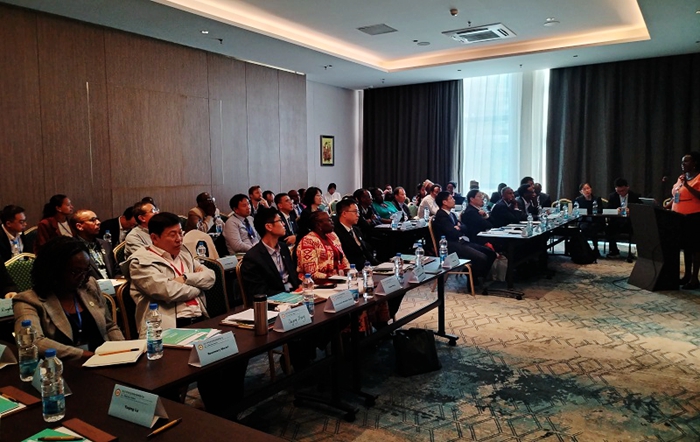
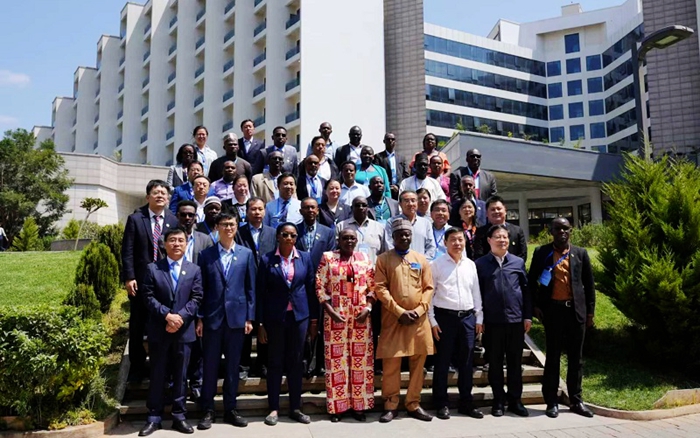
On 28 October, the side event titled “Crop Science Cooperation for China–Africa Food Security” was held in Addis Ababa, Ethiopia during the 2025 General Assembly of the China–Africa Agricultural Science and Technology Innovation Alliance (CAASTIA). More than 60 experts and scholars from agricultural research institutions and enterprises from China and Africa engaged in in-depth discussions on frontier technologies and cooperation models across key crops including rice, soybean, groundnut (peanut), potato, and sesame. The side event was co-hosted by the Institute of Crop Sciences, Chinese Academy of Agricultural Sciences (ICS-CAAS), the Oil Crops Research Institute, Chinese Academy of Agricultural Sciences (OCRI-CAAS), the Institute of Vegetables and Flowers, Chinese Academy of Agricultural Sciences (IVF-CAAS), and the China National Rice Research Institute, Chinese Academy of Agricultural Sciences (CNRRI-CAAS). Sun Tan, Vice President of the Chinese Academy of Agricultural Sciences (CAAS), attended the event.
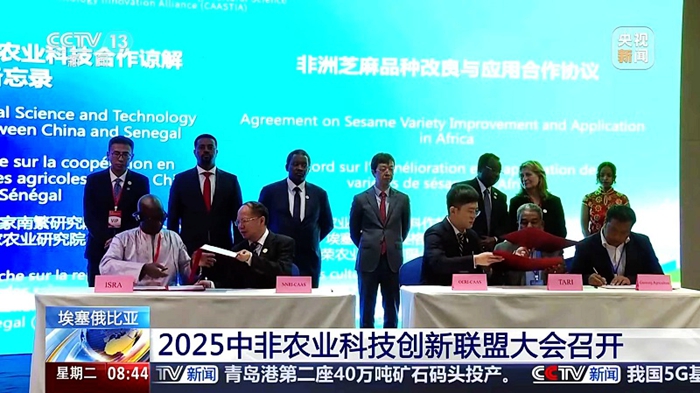
At the main-venue activities of the 2025 CAASTIA General Assembly, OCRI-CAAS signed a Cooperation Agreement on African Sesame Variety Improvement and Application with the Tigray Agricultural Research Institute (Ethiopia). As one of the first-batch cooperation projects of CAASTIA, the agreement was officially released at the General Assembly, marking a new stage in which China–Africa crop science cooperation is moving from academic exchange to tangible, on-the-ground implementation.
Participants held lively discussions under three themes: “Climate Response: Priority R&D Areas for Crop Application Technologies,” “Industrial Implementation: Pathways to Enable the Commercialization of Crop Science and Technology,” and “Deepened Synergy: Exploring New Models for China–Africa Agricultural S&T Cooperation in the New Era.” Multiple points of consensus were reached. Dr. Muez Berhe Gebremedhin (Muez Berhe), Senior Researcher at the Tigray Agricultural Research Institute, and Professor Lei Yong, Chief Scientist for Groundnut (Peanut) Genetics and Breeding at OCRI-CAAS, delivered presentations on “Development and Prospects of Sesame and Other Oil Crops in Ethiopia and Africa” and “Progress in Peanut Genetic Improvement and Breeding of New High-Yield, High-Quality, Disease-Resistant Varieties in China,” respectively.
The side event served as a bridge for China–Africa exchanges in crop science and consolidated shared understanding on cooperation for food security. Participants agreed that food security is a strategic concern for both China and Africa. Africa has immense agricultural potential, while China has well-established experience in crop breeding and technology translation—creating strong complementarities and broad prospects for cooperation. In the face of global challenges posed by climate change and food security risks, China and Africa should further strengthen agricultural science and technology cooperation, focus on breakthroughs in key technologies, accelerate industrial application of research outputs, and explore efficient and sustainable pathways for collaboration. Building on this event, the two sides will continue to deepen China–Africa crop science cooperation, contribute China–Africa wisdom and China–Africa solutions to building a closer China–Africa community with a shared future and to safeguarding global food security.