




CIAR Co-Hosts “From Climate Pathways to Farm-Level Action” Dialogue During COP31
On November 16, 2026, during the 31st Conference of the Parties to the United Nations Framework Convention on Climate Change (COP31), the Center for International Agricultural Research (CIAR), Chinese Academy of Agricultural Sciences (CAAS), co-hosted a dialogue titled “From Climate Pathways to Farm-Level Action: Trade, Finance and Agrifood Value Chains” at the Food and Agriculture Pavilion in Antalya, Türkiye. CIAR organized the event with its partners, including the International Food Policy Research Institute (IFPRI), Fundação Getulio Vargas (FGV), the Brazilian Business Council for Sustainable Development (CEBDS). More than 40 guests from worldwide attended in person, and the event was livestreamed worldwide.
Dr. Jieying Bi, Director of the General Office at CIAR, took part in the roundtable discussion. Other panelists included Ms. Fernanda Monteiro, Director of Climate and Energy at CEBDS, Ms. Juliana de Lavor Lopes, Sustainability Director at AMAGGI, Ms. Camila Estevam, Senior Researcher at the FGV Center for Agribusiness Studies (FGVAgro), and Prof. Kevin Chen, Qiushi Chair Professor at Zhejiang University and Senior Research Fellow at IFPRI. Dr. Todd Rosenstock, Director of CGIAR’s Climate Action Program, moderated the roundtable.
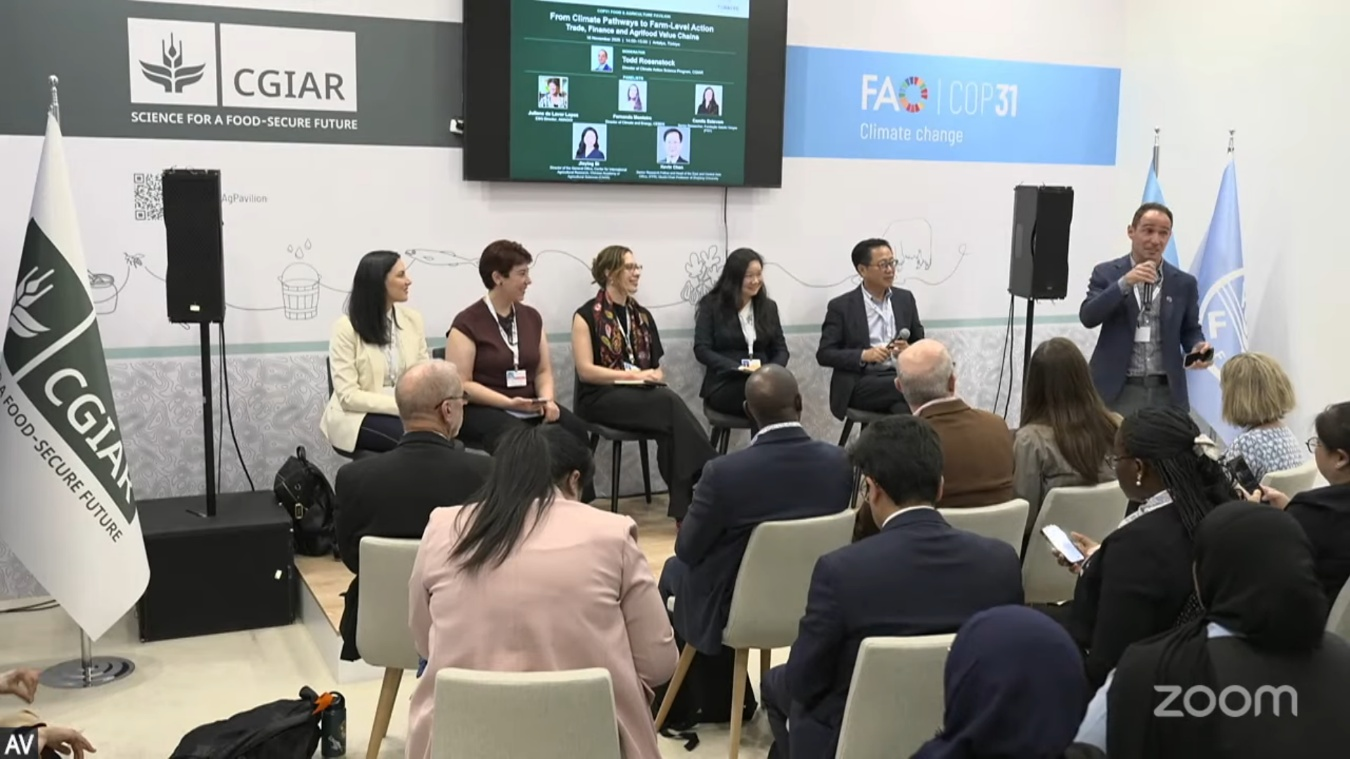
Panelists at the dialogue in Antalya, Türkiye
The dialogue focused on how to translate agricultural emissions reduction targets into action at the farm level. Drawing on Brazil’s experience with low-carbon agriculture and on agricultural trade between China and Brazil, panelists discussed the costs, financing constraints and market risks farmers face when adopting emissions-reducing technologies. They explored how procurement incentives, technical services and risk-sharing mechanisms could help more farms adopt low-carbon practices. Panelists also discussed how traceability data and emissions monitoring results could inform companies’ procurement decisions and financial institutions’ investments, and how small and medium-sized farms could gain better access to green credit and technical support.
During the roundtable discussion, Dr. Bi proposed that China and Brazil conduct long-term joint research on soybean and beef supply, demand and sustainability, make their traceability systems interoperable and pursue mutual recognition of relevant standards. She also proposed joint trials of lower-emission practices such as degraded pasture restoration and the use of green finance to share farmers’ transition costs.
Dr. Bi highlighted the Platform for the China–Brazil Green Food Value Chain as an example of how bilateral cooperation can advance low-carbon agricultural trade, and introduced its website, available in Chinese, English and Portuguese. Looking ahead, she called for lasting partnerships among Brazilian producer organizations, Chinese buyers and research institutions in both countries so that more farmers, especially smallholders, can adopt and benefit from low-carbon practices.
The dialogue marked the first time CIAR had hosted an event during a UN Climate Change Conference. During the discussion, participants expressed interest in China–Brazil cooperation on green agrifood value chains and explored how lessons from that cooperation could be applied in other regions.